How to Rank in the Google Maps 3-Pack in Florida: The 2026 Playbook
If you run a service business in Florida and the phone is quiet, the Google Maps 3-Pack is usually the first place to look, and knowing how to rank in the Google Maps 3-Pack is what puts your business in front of ready-to-call customers. They searched for something like “plumber near me” or “AC repair Tampa” on their phone, and they rarely scroll past those three listings. Ranking there does not mean having the prettiest website or the longest history. It means Google trusts that your business is relevant, close enough, and well regarded for that exact search.
So, in plain terms, here is how to rank in the Google Maps 3-Pack in Florida in 2026: you need a complete and accurate Google Business Profile with the right primary category, a steady stream of genuine recent reviews, consistent business details across the web, and a website that backs up the services and areas you claim to serve. You cannot pay for a spot, and you cannot fake your location. But you can control almost everything else, and in most Florida markets that is enough to move from invisible to one of the three.
This matters more in Florida than in many other states because so much local work is urgent and mobile. A homeowner with a burst pipe in Orlando, a restaurant owner with a broken walk-in cooler in Miami, or a family locked out in Jacksonville is not browsing. They are calling the first trustworthy business they see. For service businesses, that is the whole game: calls, not clicks. A top-three map spot puts your name, rating, review count, hours, and call button in front of that customer at the exact moment they need you. A ranking on page two of the organic results, however well deserved, simply does not get the same phone.
Google itself says local results rest mainly on three factors: relevance, distance, and prominence. Understanding those three words, and what you can actually do about each one, is the entire playbook. Everything else is detail.
Relevance: matching the search
Relevance is how well your profile matches the search. If someone searches for “emergency electrician,” Google needs to be confident you are an electrician, that you offer emergency work, and that you serve their area. The single biggest relevance lever is your primary category. It sounds small, but it is the field that decides which searches you are even eligible for. An electrician listed under a vague general category will lose to a competitor whose primary category is exactly right, even if the vague listing has more reviews. Pick the most specific category that describes your core work, add sensible secondary categories, and then list your actual services in the profile, using the words customers use. Do not stuff keywords into your business name. That is one of the fastest ways to get a profile suspended, and a suspended profile ranks nowhere.
Your website has to agree with your profile. If your profile says you do drain cleaning in Tampa but your website never mentions drain cleaning or Tampa, Google has less reason to believe either one. Service pages and city pages that describe real work, real areas, and real customer problems give Google the corroboration it needs. That is also why a profile linked to a generic homepage often underperforms one linked to a page that matches the business. If you want help with your Google Business Profile, start with the profile itself, then make sure the website behind it tells the same story.
Distance: the factor you cannot change
Distance is the factor you cannot change, and it is worth being honest about. Google ranks partly on how close your business is to the person searching at that moment. You will rank more easily near your real address and less easily across town, and no legitimate tactic changes that. What you can control is accuracy. Make sure your address and service area are correct and realistic. Service-area businesses that do not serve customers at a physical address should set a service area they genuinely cover, not the whole state. Claiming everywhere signals relevance nowhere. Consistent listings across the web also help Google trust your location data. When directories disagree about your name, address, or phone number, Google treats your location as less reliable, and that costs you.
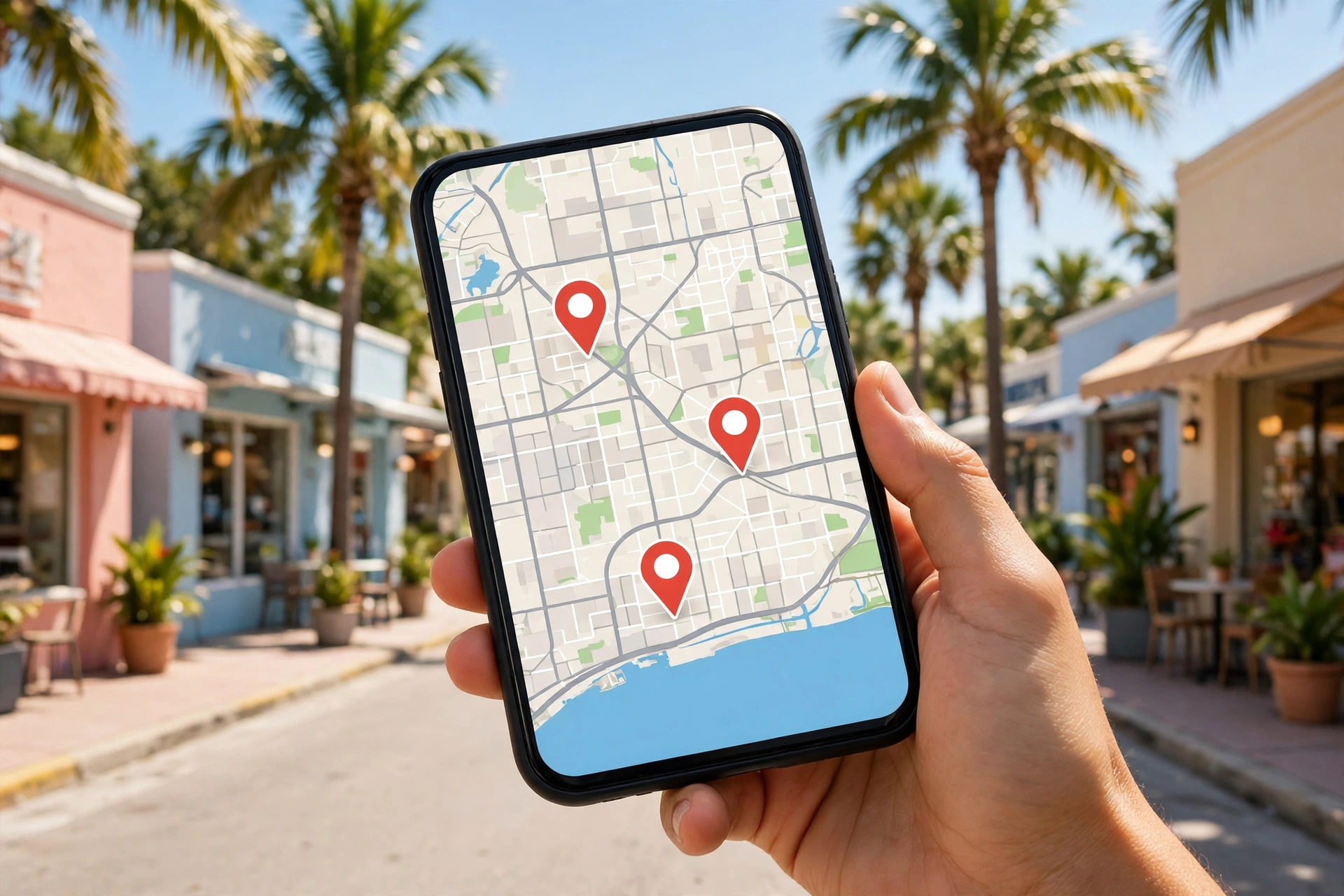
This is also why checking your own ranking from your office desk is misleading. Map results change as the searcher moves. You might be number one for someone a few blocks away and fifth for someone on the other side of town. That is normal, and it is why serious local SEO measures visibility across a grid of points in your service area rather than a single search. Judge progress by whether your top-three radius is growing, not by one lucky search.
Prominence: reviews and trust
Prominence is the factor most Florida service businesses underinvest in, and it is where most of the work pays off. Prominence is Google’s read on how well known and trusted you are, built from reviews, citations, links, mentions, and engagement across the web. Reviews are the strongest prominence signal you can actively influence. Volume matters, recency matters, and the words in reviews matter too. A steady flow of recent, genuine reviews beats a large pile of old ones. Customers notice the same thing: most people look for reviews from the last few months before they call. A review that naturally mentions the service and the city, like “fixed our AC the same day in Clearwater,” tells Google and the next customer more than a bare five stars ever will.
Building that flow is unglamorous work, and that is exactly why it works. Ask every happy customer, make it easy with a direct link or QR code, and reply to every review, good and bad. Never buy reviews, never offer incentives for positive ones, and never post fake ones. Google removes them, customers spot them, and the short-term bump is not worth the risk to your profile. A steady, honest review system, applied week after week, is what separates businesses that stay in the pack from businesses that flash in and out of it.
Photos and activity help in a quieter way. Recent photos of real jobs, real vehicles, and real team members make your listing look alive and trustworthy to both Google and customers. Short profile posts about seasonal work, like hurricane season preparation or summer AC tune-ups in Florida, keep the profile current. Posts alone will not carry you into the top three, and anyone who sells you a posting package as a ranking shortcut is overselling it, but an active, accurate profile is part of the overall picture of a real, operating business.
Citations and local links are the rest of prominence. A citation is simply a mention of your business name, address, and phone number on another site, like a directory or a local chamber page. They still matter in 2026, not as a numbers game but as a consistency check. A handful of accurate, relevant listings beats hundreds of spammy directory submissions. Local links work the same way. A link from a local supplier, a community organization, a local news story, or a partner business tells Google you are part of the local fabric. One real local link is worth more than a dozen generic ones.
A practical sequence to follow
Now put this together as a practical sequence for a Florida service business. First, confirm the profile is verified and eligible, with no suspension notice and no duplicate listing competing with it. Duplicates split your reviews and confuse Google, so resolve them before anything else. Second, fix the primary category, services, hours, and service area. Third, check that your name, address, and phone number match everywhere they appear. Fourth, start the review habit and keep it going every week. Fifth, build or fix the service and city pages on your website so they match the profile. Sixth, earn a few real local links and clean up the citations that matter. Seventh, measure with a grid across your area and by calls, not by a single search or a single ranking report.
A realistic timeline
A word on timelines, because this is where many owners get frustrated. Category and completeness fixes can change visibility in a few weeks. Reviews and prominence build over two to six months. If someone promises you the top three in seven days, they are either selling ads or selling something Google will eventually punish. The honest version is the one our own clients hear: the profile work is fast, the trust work takes time, and the businesses that do both are the ones still in the pack a year later. If you are unsure where you stand today, a free audit of your local presence will show you which of these levers is actually holding you back, whether it is a category problem, a review gap, or a website mismatch.
The Florida factor
Florida adds its own wrinkles. Seasonal demand swings are real. AC companies peak in summer, roofers after storms, and pest control on its own cycle. A profile that stays accurate through those swings, with hours updated for holidays and storm response, earns trust when it counts. Competition also varies sharply by city. Miami is crowded and expensive in attention terms, while smaller markets reward a complete profile and a modest review lead much faster. That is why what it takes to win in one Florida city is not a copy-paste job for the next one. The playbook is the same, but the competitive bar, and the number of reviews you need to clear it, is local. Aim to be competitive with the current top three in your own area, not with a statewide average.
Does the 3-Pack still matter with AI answers?
One more thing owners ask about constantly: does the 3-Pack still matter now that AI answers appear on so many searches? For plain local searches, a service plus a place, the map still shows up the overwhelming majority of the time, and it is still where the call happens. AI answers may shape the research step, but when a customer is ready to book, they still tap a map listing, check the reviews, and call. The same work that wins the pack, accurate categories, real reviews, consistent details, clear service pages, also helps AI systems understand and cite your business. You are not choosing between Maps and AI. You are building the same foundation for both.
The bottom line
The bottom line is simple, even if the work is not instant. Be the business Google can most confidently recommend for that search, in that place, at that moment. Get the category right, keep every detail accurate, earn reviews every week, keep your listings consistent, and back it all up with a website that proves you do the work you claim. Do that for a few months, measure by calls, and the map starts to work for you instead of against you. For Florida service businesses, that is the difference between waiting for the phone to ring and having it ring with the right kind of customer.
If the phone is quiet and you are not sure whether the problem is your category, your reviews, or something else entirely, get an honest check before you spend on ads or a new website. The fix is often smaller than owners expect, and it starts with the profile customers already see.
Frequently Asked Questions
What is the Google Maps 3-Pack?
The Google Maps 3-Pack, also called the local pack, is the box of three business listings shown with a map at the top of Google search results for searches with local intent, like “plumber near me” or “AC repair Orlando.” It sits above the regular organic results and is drawn from Google Business Profiles, not from web pages alone.
What are the three main ranking factors for the Google Maps 3-Pack?
Google says local results are based mainly on relevance, distance, and prominence. Relevance is how well your profile matches the search, distance is how close your business is to the searcher, and prominence is how well known and trusted your business appears, based on reviews, citations, links, and engagement across the web.
Can I pay Google to rank in the Google Maps 3-Pack?
No. You cannot pay for a 3-Pack spot. Paid ads can appear above or alongside the map, but the three organic map listings themselves are earned through relevance, distance, and prominence. Anyone selling a guaranteed paid placement in the 3-Pack is not selling what Google actually offers.
What is the most important field on a Google Business Profile for Maps ranking?
The primary category is the single biggest relevance lever. It decides which searches you are even eligible for. Choose the most specific category that describes your core work, add sensible secondary categories, and list your actual services in the profile using the words customers use.
Do reviews really affect Google Maps ranking, or just customer trust?
Both. Reviews are one of the strongest prominence signals Google can actively measure, and customers use them to choose. Volume, recency, and the words in reviews all matter. A steady flow of recent, genuine reviews outperforms a large pile of old ones, and reviews that naturally mention the service and city help both Google and the next customer.
Should I ever buy reviews or offer incentives for positive ones?
No. Never buy reviews, never offer incentives for positive ones, and never post fake ones. Google removes them, customers spot them, and the short-term bump is not worth the risk to your profile. Ask every happy customer, make it easy with a direct link or QR code, and reply to every review, good and bad.
How long does it take to rank in the Google Maps 3-Pack?
Category and completeness fixes can change visibility in a few weeks. Reviews and prominence build over two to six months. If someone promises you the top three in seven days, they are either selling ads or selling something Google will eventually punish. The profile work is fast, the trust work takes time, and the businesses that do both are the ones still in the pack a year later.
Why do my Map rankings change depending on where I search from?
Because distance is a ranking factor. Map results change as the searcher moves. You might be number one for someone a few blocks away and fifth for someone on the other side of town. That is normal, which is why serious local SEO measures visibility across a grid of points in your service area rather than a single search.
Do I need a physical storefront to rank in the Google Maps 3-Pack?
Not necessarily. Service-area businesses that do not serve customers at a physical address can set a service area they genuinely cover, rather than claiming the whole state. What matters is that your address and service area are correct and realistic, and that your business details are consistent everywhere they appear.
What are citations, and do they still matter in 2026?
A citation is a mention of your business name, address, and phone number on another site, like a directory or a local chamber page. They still matter in 2026, not as a numbers game but as a consistency check. A handful of accurate, relevant listings beats hundreds of spammy directory submissions.
Does the Google Maps 3-Pack still matter now that AI answers appear in search?
Yes, for plain local searches, a service plus a place, the map still shows up the overwhelming majority of the time, and it is still where the call happens. AI answers may shape the research step, but when a customer is ready to book, they still tap a map listing, check the reviews, and call. The same work that wins the pack also helps AI systems understand and cite your business.
What should I fix first if my Florida business is not in the 3-Pack?
Start with the profile itself: confirm it is verified and eligible, with no suspension notice and no duplicate listing competing with it. Then fix the primary category, services, hours, and service area, check that your name, address, and phone number match everywhere they appear, and start the review habit every week. If you are unsure which lever is holding you back, an honest audit of your local presence will show whether it is a category problem, a review gap, or a website mismatch.